databébé
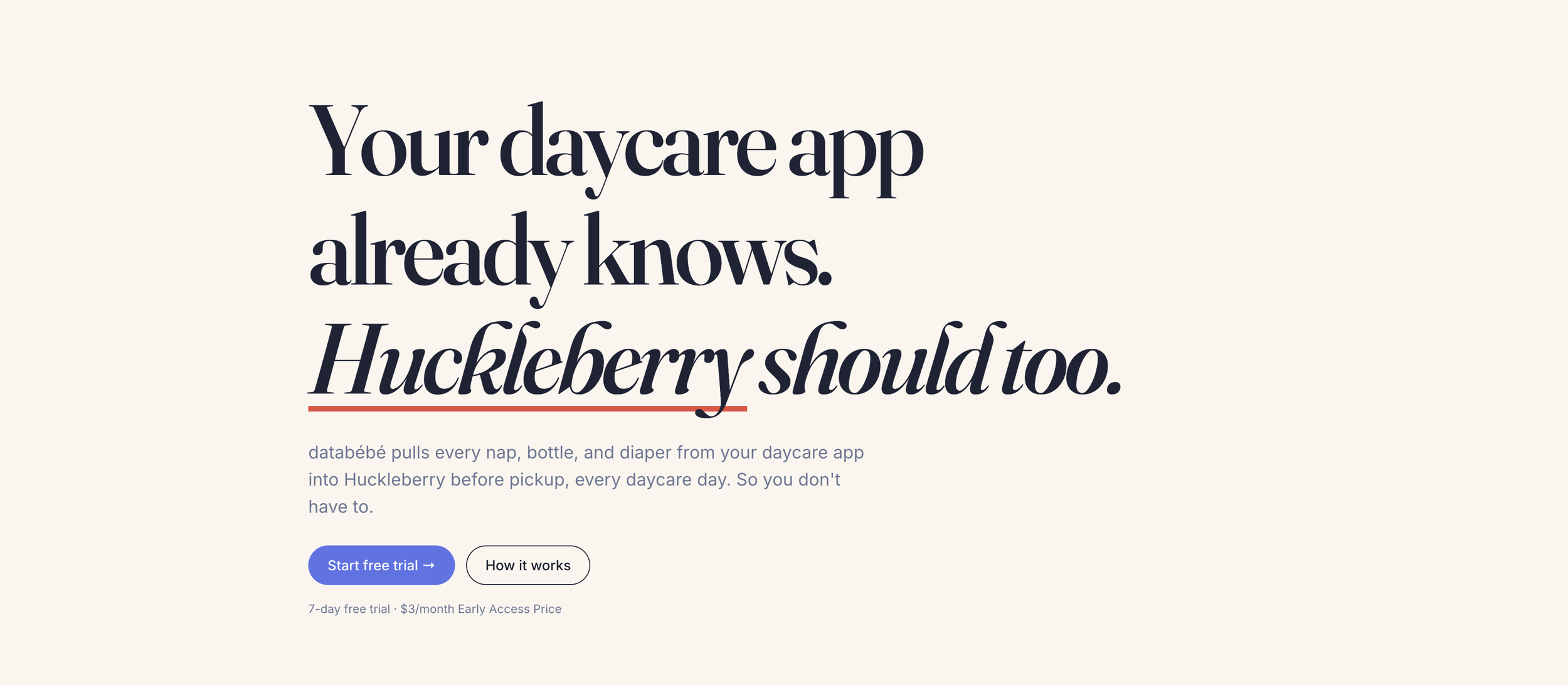
Parents of daycare kids re-type their child's day - naps, bottles, diapers - from the daycare's app into their baby tracker every night. databébé is the connector that makes that automatic.
1 month first commit → launch · 2 integrations · live & taking payments
Team
Just me - design, code, copy, and ops with Claude as build partner.
Results so far
First commit → public launch: 1 month (2 weeks active build)
Live and taking payments since June 2026
2 integrations shipped with zero public APIs - one scraped, one reverse-engineered
First users onboarded at launch
Problem
If you track with Huckleberry and your child goes to daycare, you re-enter everything by hand - every nap, bottle, and meal, every day - or the sleep recommendations break. The data already exists: his teachers logged it all in Lillio. But the apps don't talk, so at pickup I'd stand in the parking lot re-typing his day just to answer the questions that decided our evening: when did he last eat, when did he last sleep, errands or meltdown, dinner now or family dinner later.
Businesses have a whole tool category for making apps talk. Parents have nothing; either stop tracking or manually re-enter data every day.
Solution
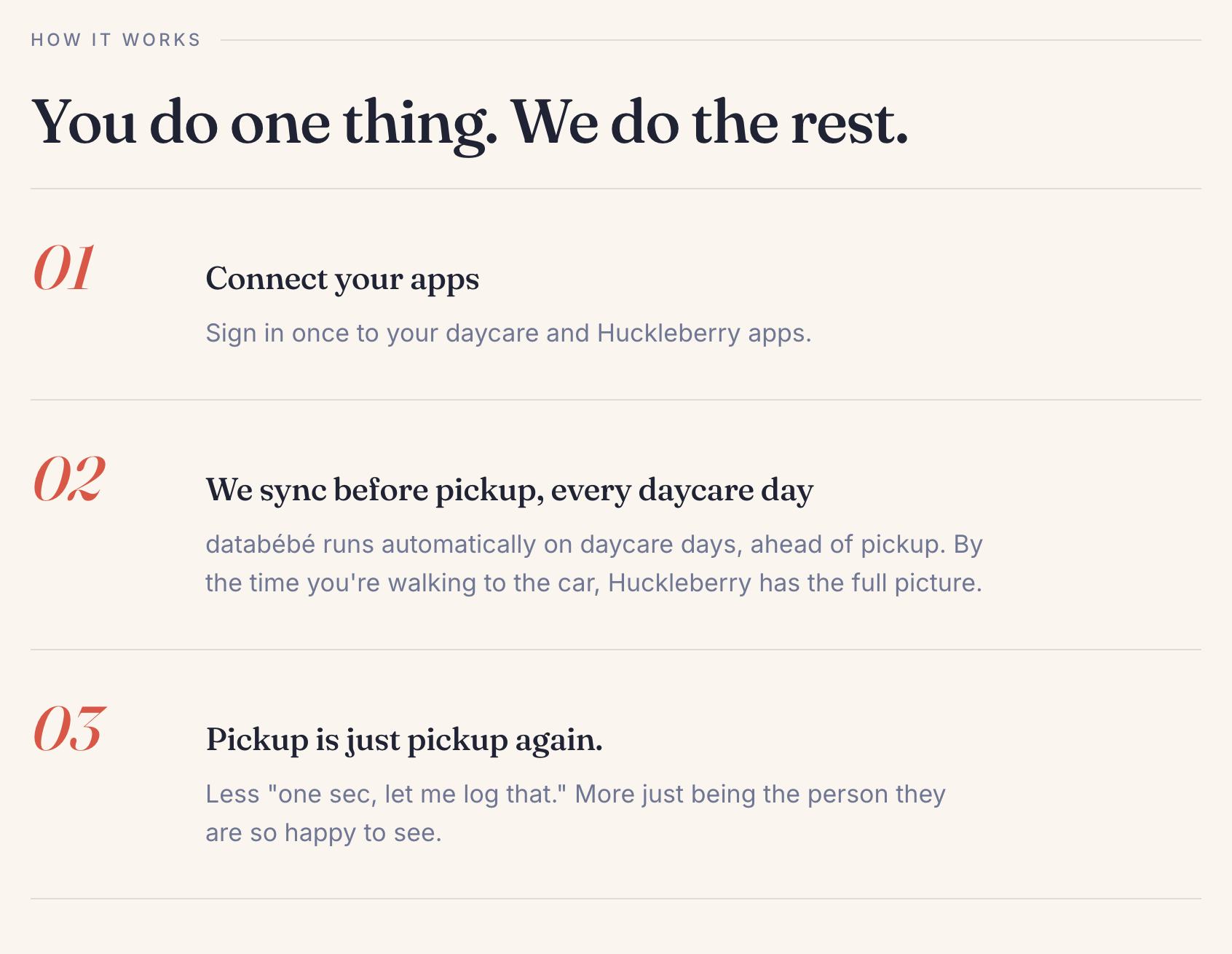
A sync service: connect your daycare app once, and your child's day flows into Huckleberry automatically. FastAPI, Supabase, Stripe, encrypted credentials - shipped solo in two active weeks.
Design decisions
The signup flow leads the roadmap. The riskiest assumption wasn't "will parents pay,” it was "which integrations matter." So the first step of signup asks one question: what app does your daycare use? Supported apps continue to trial; unsupported apps hit a waitlist. Every waitlist signup is a ranked, zero-cost vote for the next integration, from people qualified enough to have started signing up. V1 put this selector on the homepage itself; it moved into the funnel once the landing page earned a stronger promise to lead with ("we sync before pickup"), which is the right order: the homepage sells the outcome, the funnel captures the roadmap.
Next I'd measure: Next I'd measure: waitlist-to-trial conversion when a requested app ships.
This is the live product, click around.
Trust is the conversion bottleneck, so everything is designed against it. The ask is steep for a consumer subscription: hand over your daycare login. Every layer works that one objection - warm cream and periwinkle rather than the expected SaaS blue, a welcome email that leads with the outcome ("One less thing on your plate"), encryption stated in plain English at the point of credential entry. Even the FAQ's "Not yet" on the single-child limit is a trust call: limitations you state cost less than limitations users discover.
Next I'd measure: drop-off at the credential step vs. the pricing step.
AI leverage is infrastructure, not prompting. One person shipping design, frontend, a scraper, and a reverse-engineered Firebase integration in two active weeks isn't a prompting trick. A single Claude.ai spec holds the design tokens, copy rules, and settled architecture decisions, synced between claude.ai and Claude Code - so every session ships consistent product instead of drift. It's a design system extended to cover language and code.
The stack, chosen for solo speed: FastAPI on Railway, Supabase Postgres, Stripe billing, Resend email, APScheduler for sync jobs, Fernet for credential encryption - standard, managed tools so the novel work (the integrations) could be the full focus..
Distribution is the current constraint, and it's a design problem too. With first users onboarded and happy, the bottleneck moved from product to awareness. Two channels, two different jobs. Instagram (@databebehq) for reach - building out the organic presence first, with paid to follow once the page can convert the clicks it earns. And AEO-driven content for capture, because the search landscape here is empty in the best way: query the problem today and you get Reddit threads of parents concluding nothing exists. Those threads are demand evidence and a distribution vacuum at once - the first blog post is written to be the answer search and AI assistants return where there currently is none. Same voice in both channels as the product: "one less thing on your plate," no growth-hack theatrics.
Next I'd measure: organic engagement by content angle now, then cost per trial start once paid launches.
What’s next
Brightwheel integration and multi-child support, prioritized by waitlist demand.