AI System Prompt Generator
Agent.ai is an AI agent marketplace and builder platform, acquired by HubSpot in 2026. I built the behavioral and content component system governing what its agent outputs contain - and the generator that turns that system into ready-to-implement specs.
30+ agent outputs, one system · validated by blind AI run · creates specs engineers build from directly
Team
Me - systems design and methodology
Problem
Every agent's output was designed from scratch, inside its system prompt, by whichever engineer built it. Product decisions such as what to show when data is thin, how to mark AI inference versus sourced fact, or when to fail loudly versus hide a section product decisions, were made ad hoc, thirty-plus times, with no shared rules. The result was inconsistent outputs and engineers doing design work nobody had assigned them.
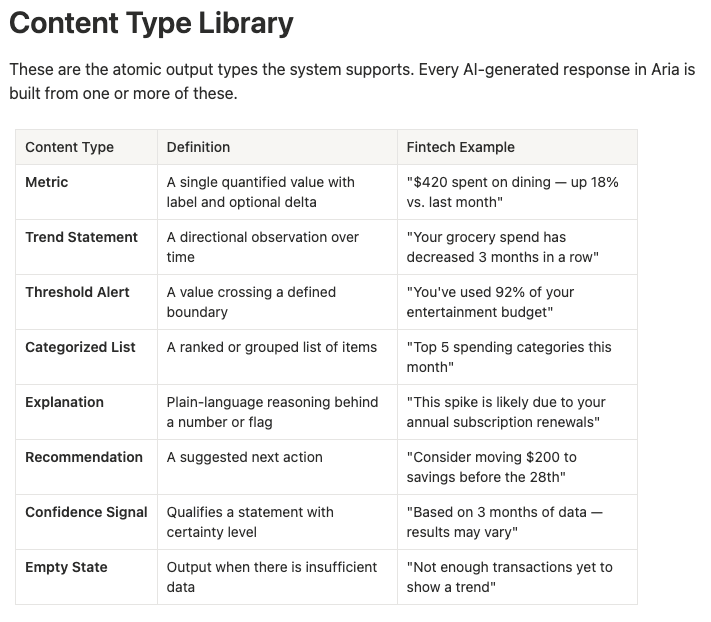
The system writes the spec; the designer reviews the judgment calls. Feed the bundle a PRD and it produces a designer-reviewable output spec such as sections, content types, edge cases, and the calls it made flagged for review, including what it couldn't determine from the inputs alone. Engineering gets the core of each system prompt already written, instead of starting from scratch.
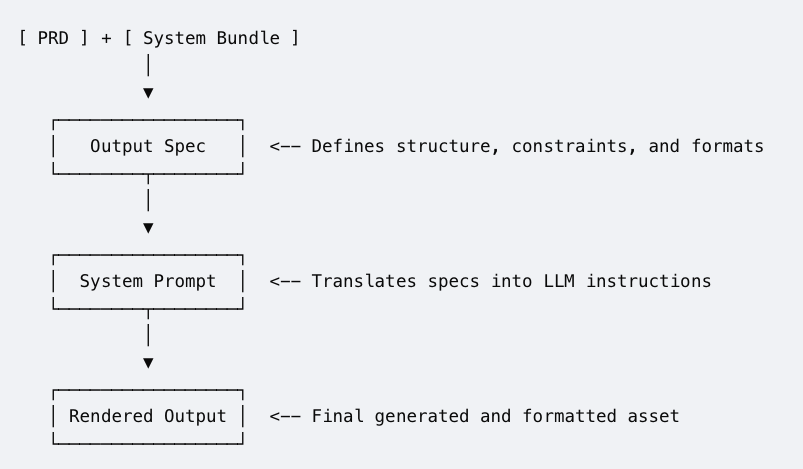
Behavioral defaults are pre-answered once, inherited everywhere. Uncertainty signaling, failure-state voice, inferred-versus-sourced attribution, escalation behavior were all decisions engineers were improvising per agent became system rules. Every output marks inference the same way; every empty state falls back the same way.
Validated blind, not by trust. The real test: a fresh AI conversation with no project history, given only the bundle and a new agent's PRD. The blind run produced a better spec than the previous context-heavy conversation and surfaced four improvements that were promoted to system-wide rules. The system compounds: every spec generated makes the next one better.
Design decisions
Repeatable content decisions, not a UI components. The audit extracted what agent outputs are actually made of: a content type library (Insight, Scoring, Warning, Identity Header...), structural primitives, composite patterns, and system-wide rules every output inherits. Design-systems thinking, applied to what outputs contain rather than how components look.
What didn’t work
The first validation wasn't strict enough — the AI had lived through the audit, so passing proved little; the blind protocol came from admitting that. Early runs also invented duplicate content types (splitting nested fields into new types), which became a documented handling rule. And detailed PRDs produced worse specs than stripped-down ones — the system reasons better from goals than from prescriptions, so the input format got simpler, not richer.
What’s next
This is now the core of my consulting practice, building this layer for AI-native teams as the AI Output System Build.